
Panel Methods in Hypersonics
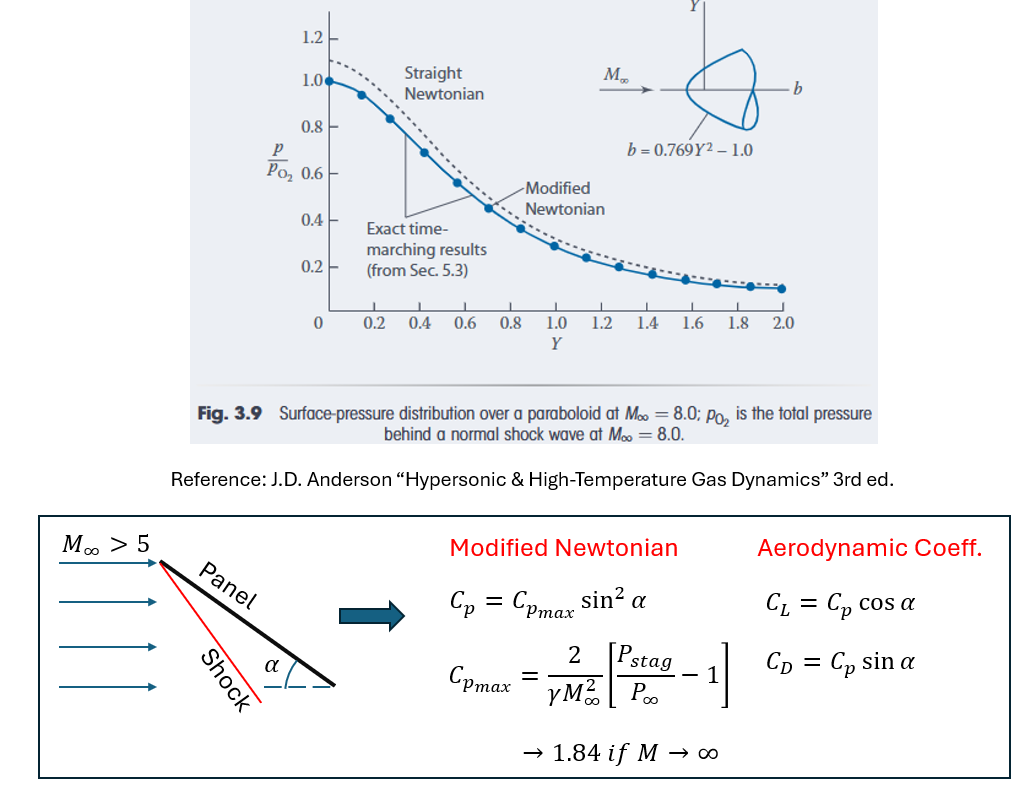
Panel methods are among the most practical low-fidelity tools in hypersonic aerodynamics, balancing simplicity with useful accuracy. They are based on Newtonian flow theory, where the incoming momentum normal to a surface element is brought to rest while the tangential component is retained — behavior commonly seen when a jet deflects over an inclined flat plate.
With inviscid assumptions, Newtonian theory can be extended to curved bodies. The modification introduced by Lester Lees (Modified Newtonian Theory) scales the surface pressure coefficient using stagnation-point pressure, enabling surprisingly accurate pressure distributions for hypersonic geometries, as shown below. In hypersonic flow, boundary layers are typically thin relative to body scale, and surface pressures are largely governed by the inviscid outer flow in the shock layer. As a result, Modified Newtonian theory captures the dominant pressure loading, despite neglecting viscous effects and viscous–inviscid interaction.
In this context, Modified Newtonian theory (a surface impact method) is applied locally on discretized surface panels to estimate pressure loading, rather than a classical potential-flow panel solver.
Importance to Hypersonic Aerodynamics
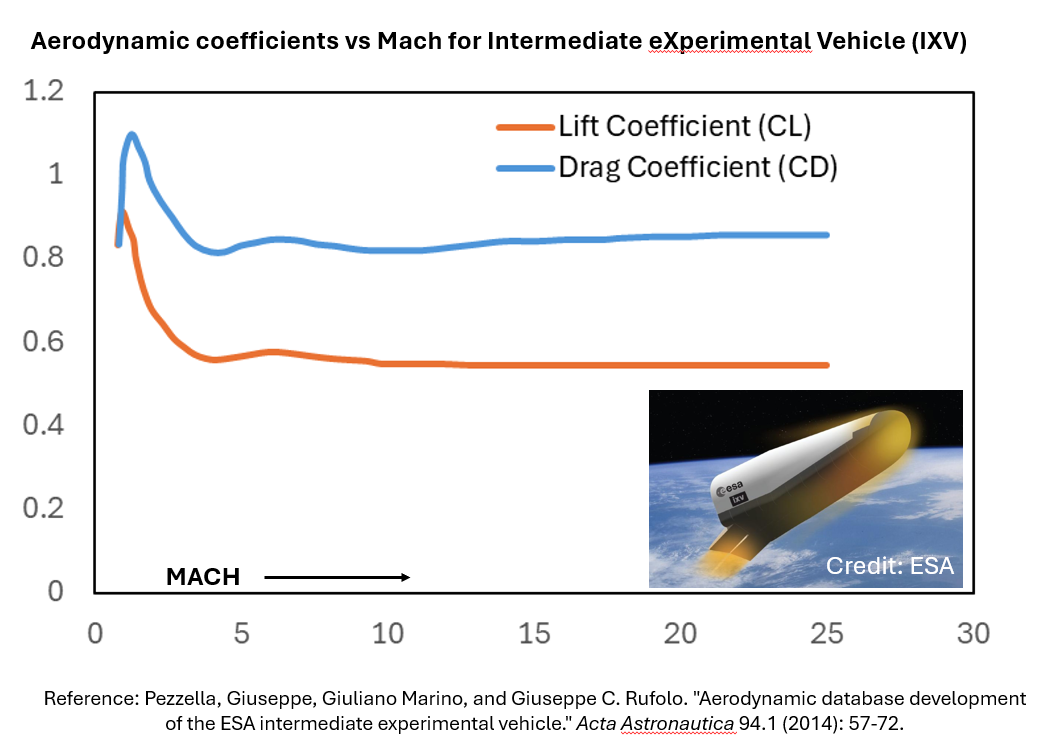
Pressure coefficients from Modified Newtonian theory can be integrated to estimate lift and drag. At hypersonic speeds, pressure (wave) drag generally dominates viscous drag, making pressure-based methods well suited for early design and trajectory analysis. These aerodynamic coefficients directly influence control, stability, and flight behavior.
A key feature of hypersonic aerodynamics is its asymptotic behavior (https://lnkd.in/dtdqTcDD). In the hypersonic similarity limit, coefficients such as CL and CD become weakly dependent on Mach number, a trend reflected in Modified Newtonian predictions and illustrated below. Consequently, hypersonic aerodynamic databases are often constructed primarily as functions of body attitude — angle of attack, sideslip, and roll. As the flow transitions toward the supersonic regime, Mach effects reappear and explicit Mach sweeps become necessary.
Panel Methods for Laminar Heat-Flux Estimation
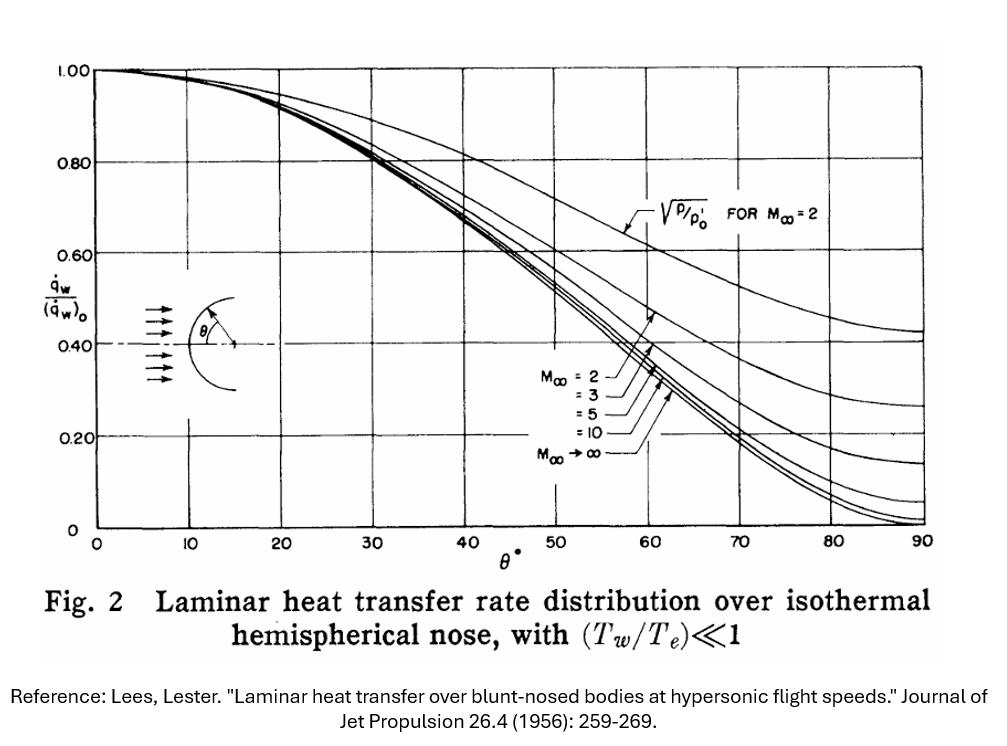
Under restricted conditions, panel methods can also estimate wall heat flux. Lester Lees showed that for laminar flow over a zero-angle-of-attack hemispherical blunt body, surface heat flux follows a cosine-squared variation relative to stagnation-point heat flux, based on panel inclination. While effective for this canonical case, the relation breaks down for non-spherical geometries and non-zero angles of attack (https://lnkd.in/d2G-fsKc).
For such cases, alternative engineering methods — such as the Reference Temperature Method — provide more reliable heat-flux estimates as geometry, attitude, and boundary-layer effects become more complex.
